
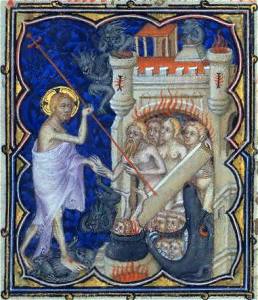
The Harrowing of Hell, from a fourteenth century manuscript Wikipedia
The Divine Comedy: Dante’s Journey to Freedom, Part 1 – began 15th October 2014 (Georgetown University).
I stumbled across this MOOC at edX last week. Goodness knows why I’m even looking at more subjects, doing far too many now. I’ve never studied literature before (oh hang on – there was Lord of The Flies in high school! ) and this seems really interesting and thought-provoking. Apparently, if I apply due diligence, I shall come away from this experience the richer, and with a good idea of who I am. Yep, sounds promising.
You will question the meaning of human freedom, responsibility, and identity by reading and responding to Dante Alighieri’s Divine Comedy. The Comedy, which is richly steeped in the medieval culture of the 14th century, still speaks vividly to modern readers struggling with the question, “Who am I?” Dante, as a Florentine, a poet, a lover, and a religious believer struggled with the same question in each facet of his life before coming to a moment of vision that wholly transformed him as a person.
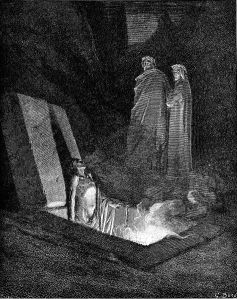
… engraving by Gustave Doré illustrating Canto X of Divine Comedy, Inferno, by Dante Alighieri. By scanned, post-processed, and uploaded by Karl Hahn (Pantheon Books edition of Divine Comedy) [Public domain], via Wikimedia Commons
I’m finding I’m able to let myself audit courses without feeling I have to submit assignments if I haven’t the time or the inclination. I’m not after certification, I keep reminding myself, so it doesn’t really matter. The ones on FutureLearn are a more relaxed format and I can go as slow as I like there. I’m loving my MOOC experience. I’m sure my brain is being enriched, and my future writing will be the better for it.
Part of the course is carried out on the university’s MyDante platform, an interactive experience, “a digital incarnation of the medieval illuminated manuscript”, where I will learn to use my upcoming contemplative reading skills, adding thoughtful annotations and insightful journal entries. I’ve watched the first two videos and the professors aren’t talking over my head, so that’s a good start!
One thing I’m really looking forward to is listening to readings of the poem in Italian, despite not knowing the language. I’m sure it will sound wonderful. I’ll work with the translations by Robert and Jean Hollander of Inferno, Purgatorio, and Paradiso (Random House).
The Divine Comedy: Dante’s Journey to Freedom, Part 2 (Purgatorio) 4 Feb 2015: (Four weeks)
&
The Divine Comedy: Dante’s Journey to Freedom, Part 3 (Paradiso) 8 Apr 2015 (doesn’t say how long)

Sandro Botticelli – Inferno, Canto XVIII Sandro Botticelli [Public domain], via Wikimedia Commons
 Christine R


You must be logged in to post a comment.