
 Pit of Vipers is the second book in the Sons of Kings trilogy written by Millie Thom. It continues the tale of Alfred of Wessex and Eadwulf of Mercia started in Book 1, Shadow of the Raven. The year is 864.
Alfred is now fifteen, and learning kingship at the successive courts of his older brothers.
Eadwulf, the Mercian who had spent time as a Danish slave, has been back in his homeland now for four years. Though settled into married life in the household of his father-in-law, a Mercian ealdorman, he cannot shake off the memory of his lost love, Freydis. On top of this, he is frustrated by failed attempts to extract vengeance on his uncle. I’ll say no more about either of those worries.
Once again the author includes a handy The Characters page to help with the old names. Names which could easily grace the pages of a fantasy novel: Aethelberht, Heahmund, Wulfrida, Dryhtwald, Paega, Katato – to name just a few. You need your wits about you, but the well-written story does quickly place everyone in context and you are never left confused.
Handy maps in both print and digital versions place the positions of the Anglo-Saxon kingdoms in perspective.
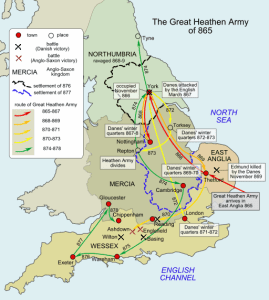
map from Wikipedia
Large bands of Scandinavian Vikings break the treaties, raiding Kent. In 865, they are joined by more Norse and Danish invaders – dubbed The Great Heathen Army – landing on the coast of East Anglia.
While some historians believe the invasion was a natural progression from the increasing raids on the Anglo-Saxon kingdom, the author has chosen to present her story from the view put forth in the Norse Sagas.
Millie Thom says on her explanatory About Book Two page:
In this version, The Great Heathen Army is led by three of the sons of the notorious Ragnar Lodbrok in response to an incident that demands reprisal …
I love the way Millie Thomas imbues her characters with personal qualities. Alfred is a different Alfred than what I came to expect from reading other historical novels where he is portrayed as extremely pious. Here, he seems no more pious than normal in those days when ailments of the flesh were considered manifestations of sin. Alfred does marry and is able to satisfy his fleshly desires without all the guilt. His hemorrhoids seem to cause less trouble, but this bother is replaced by bouts of a mysterious debilitating illness which he bears with fortitude. He hopes he will not die of the same mysterious ailment which takes some of his family.
I don’t think Eadwulf plays as great a part in this novel, but again he is a well developed character and it’s a pleasure to track the life of the ordinary Mercian household from his view-point. His loyalty’s are divided, of course, since he has strong ties with the Danish friends he had to leave behind four years earlier. I expect unfolding events in Book 3 will severely test Eadwulf’s loyalties.
The Pit of Vipers closes in the year 871. Alfred is now King of the West Saxons, and Eadwulf is given an invitation by three Danes which I don’t think he can refuse.
Overall, the story has a lovely finished feel. While I’m eager for the next book of the trilogy to be written and published, I wasn’t left with that unresolvedness you sometimes get in trilogies.
If you love historical fiction of this era, and you don’t wish for seemingly endless blow-by-blow battles, then you will enjoy Pit of Vipers. I did.
NOTE: I purchased the Pit of Vipers. I could have asked for a review copy, but I hold the standard of the author’s research and her writing in high regard and was only too happy to buy myself a copy as soon as I saw it available.
Amazon UK
Amazon US
Amazon Australia
My review of Shadow of the Raven
 Christine R
You must be logged in to post a comment.