Cee's Which Way Challenge

Cee’s Which Way Photo Challenge

dogtrailer1 WP_20141031_022 LEFT: Did you notice the scooter in the featured photo above?
cees which way

I took these photos for Cee’s Which Way Photo Challenge: 2014 #19.

We often see this fellow on his scooter with his dog in the trailer, but I’m not usually in a photo taking position. We had just packed our groceries in the car, the camera phone was handy, and I thought of Cee’s Odd Ball or Which Way photo challenge.

Heathcote’s main street is reputed to be the longest in Victoria. I’ve even seen some claims it is the longest in the Southern Hemisphere, but that sounds ridiculous. Anyway, it’s not particularly interesting, just a longer version of many other Australian towns. The population is about 3,000.  In the 1850s, up to 40,000 prospectors set up in this area at the height of the goldrush.

BELOW: McIvor Diggings, 26 July 1853
Shows Langley, Hawkes and Foster’s Stores, St. Louis Auction Mart, St. Louis Restaurant, Argus Office and St. Louis Store

The McIvor-Heathcote goldfield opened in November 1852 after a discovery by William John Bulling and two mates. A rush started early the next year, and contemporary estimates of the digger population at that time ranged from sixteen thousand to forty thousand, working the numerous gullies running into the western side of McIvor Creek. The first Commissioner of the McIvor goldfield commenced duty in Easter week, 1853. A decade later the field was basically deserted.

I’ll show you more of the town, sometime.
Standard
and other creatures

Icky Sawfly Larvae

sawfly cycle

This is from a forestry website – full info and more photos can be seen there.

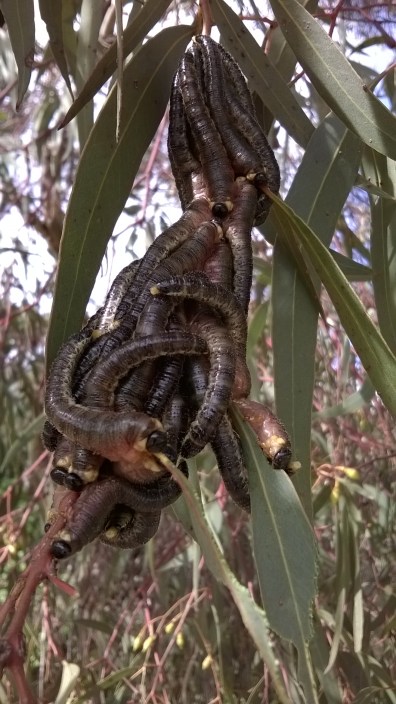
spitfire 3I thought I would delight  bore educate enlighten you with some  information about the grubs I pictured yesterday: Spitfire caterpillars,  larvae of our Australian native Steel Blue Sawfly (Order Hymenoptera). I’ve gathered information from Museum Victoria, Wikipedia, CSIRO, a Forestry site,  and a South Australian Government website.

The sawfly is a  wasp, related to the Cherry and Pear Slug.  It has a stocky body, usually a dark metallic blue, and does not sting.  It has a double pair of wings with a span of about four centimetres.  The adults are rarely seen, and spend their time hanging around their host tree.  The sawfly gets its name from the saw-like ovipositor of the female. She opens holes in the underside of the leaf and lays her eggs.

The Spitfire larvae, about 8 centimetres long, love their tucker.  Mainly active around late winter and spring, they sprawl around enmasse during the day, but at night they disport around the tree chomping gum leaves.  They can gather into groups of as many as two hundred.spitfire 1When threatened, they raise their heads and exude a yellow-green liquid, strongly flavoured by eucalyptus oil extracted from the gum leaves.

spitfires concrete

Crossing Concrete at Brisbane 2012: By Tzedragon (Captured on iPhone) [GFDL or CC-BY-SA-3.0], via Wikimedia Commons

 They did this to me, the other day. About ten of them all jerked their heads up at the same instant. Needless to say, I leapt back and didn’t bother them again. I have no idea if they do actually do spit the stuff, and I didn’t want to take the risk of anything nasty dropping in my face.

Eventually, about mid spring, the larvae are ready to pupate. Still enmasse, they make their way into the ground, burrow in several centimetres, and make themselves a strong paper-like cocoon. It might take two or three years before the adult emerges.

I intended to take fresh photos today, but the bunch had moved up the branch overnight (featured photo). I think they are fascinating, and it will be interesting to see if they do survive to pupate. Small groups of twenty or so do not always survive.  A few birds, currawongs and cuckoo-shrikes will eat them. Good luck to them!

800px-Pied_Currawong,_Blue_Mountains


Currawong

By D. Gordon E. Robertson (Own work) [CC-BY-SA-3.0 or GFDL], via Wikimedia Commons

Standard