Reptiles

Common Garden Skink

skink

Lampropholisguichenoti

I love skinks, always have. This little fellow was in my bedroom today and ran into a shoe – else I wouldn’t have captured it. I managed to grab the Nokia on the way outside. He calmly posed before I let him go – without shedding his tail!

Wikipedia says they have sharp teeth – yikes – never knew that.

The pale-flecked garden sunskink or common garden skink (Lampropholis guichenoti) is a small common skink often seen in suburban gardens in Adelaide, Melbourne, Perth, Sydney and Brisbane in Australia, but are common across most of Southern Australia and some of New South Wales. … Garden skinks feed on larger invertebrates, including crickets, moths, slaters, earthworms, flies, grubs and caterpillars, grasshoppers, cockroaches, earwigs, slugs, dandelions, small spiders, ladybeetles, ants and many other small insects, which makes them a very helpful animal around the garden. They can also feed on fruit and vegetables, but the vegetables have to be cooked for the skink to be able to eat it. …
Standard
Trees

What is this tree? Solved. (Eucalyptus platypus)

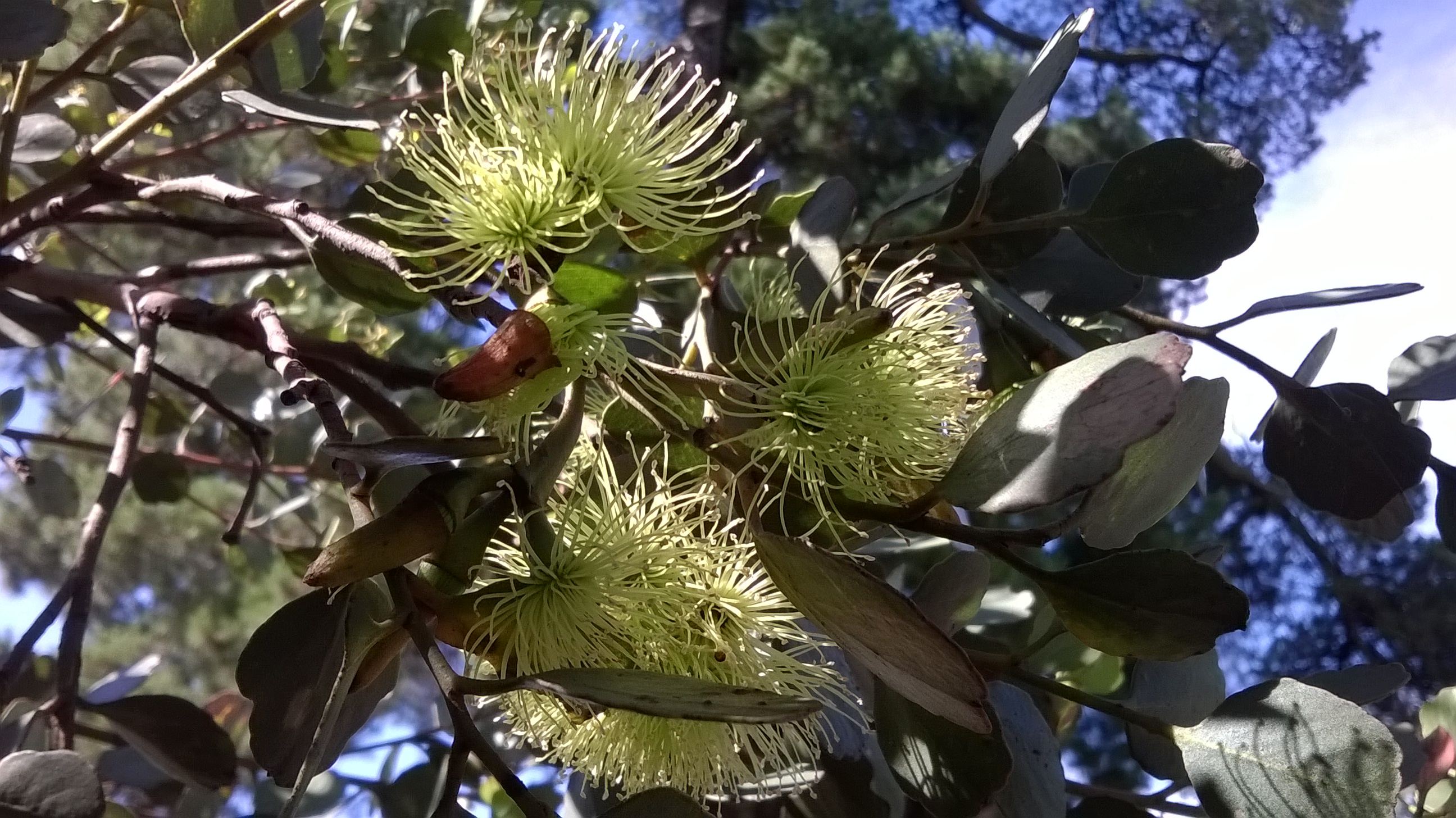
I have a blossom for this shrub, now – and discovered the name …

blossom green

Taken on the Nokia phone


From Wikipedia:

Eucalyptus platypus, also known as the Moort or Round-leaved Moort, is a small tree which occurs in an area between Albany and Esperance in Western Australia.

It is a mallee Eucalyptus and grows to between 1.5m and 10 metres in height. The canopy of the tree is dense and rounded and the leaves are elliptical to orbicular. The bark is smooth and light brown, ageing to grey.

A distinctive feature of this species are its elongated flat peduncles which are about 3 cm long and 1 cm wide. These are referred to in its specific name platypus which is derived from the Greek words πλατύς (platy: flat, broad) and πους (pous: foot). The peduncles support stalkless buds with long, conical caps in clusters of up to seven. These are followed by greenish-yellow (or occasionally white, cream or (rarely) red) flowers in spring and summer which are to some degree obscured by the dense foliage.

Well, M-R, you weren’t far wrong were close when you said it was a mallee Eucalyptus grossa. 🙂

Standard