
Last week, only a narrow swathe of straggly Paterson’s curse lined parts of the bush track to our camp by the river. I’m really pleased with the few photos of foraging bees I took (Nikon D3000), but I decided to seek out a fact or two about this weed before hitting publish.

Paterson’s curse has a high concentration of pyrrolizidine alkaloidsis, making it poisonous when eaten in large quantities by grazing animals. Those with simple digestive systems, like horses, are particularly vulnerable.
Native to Western and Southern Europe and is also known as blueweed, Lady Campbell weed, Riverina bluebell, and purple vipers-bugloss. In South Australia it is known as Salvation Jane because it has good points, too, being valuable fodder for ruminants – cattle and sheep – when natural pasture has died off.
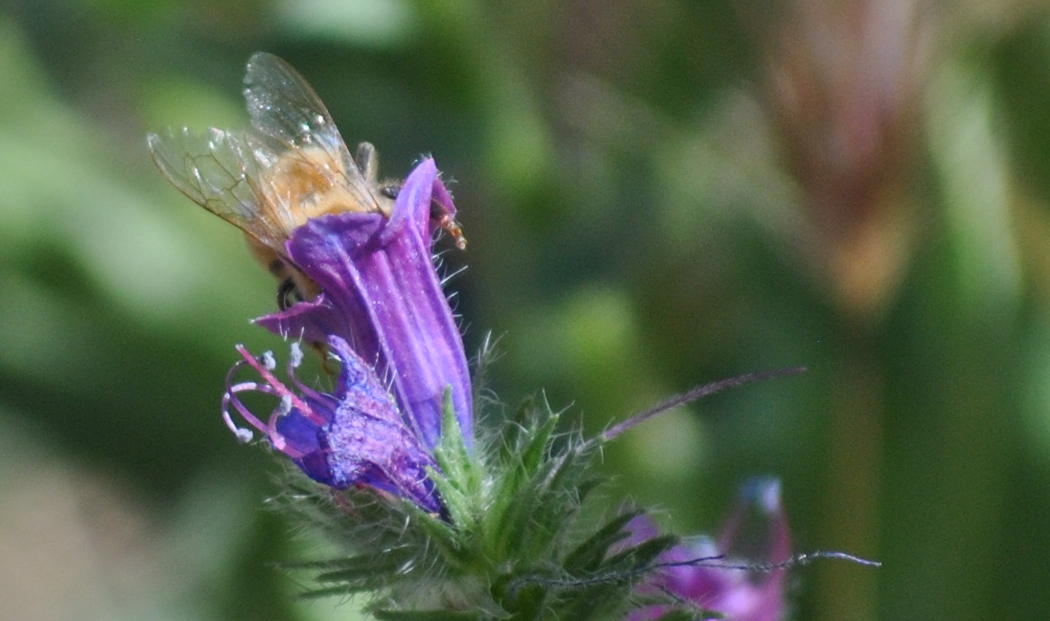
When used in honey production, the nectar has to be blended with other honey to reduce the toxins.

I love how the colour changes over the life of the bloom – from pink to blues to purples. These images have only been cropped and sharpened. I haven’t messed with the colours.

What I really wanted to know was how it got its name. Apparently, it’s thought that a Patterson family grew Echium plantagineum as an ornamental plant in their garden. It spread and took over previously productive land. I was a little disappointed at that, hoping for something more dramatic. I suppose Mrs Patterson got the blame.
I’m not surprised it would be cultivated for its beautiful flowers, though, not surprised at all.
Many thanks for dropping in!
🙂







 Christine R
You must be logged in to post a comment.